Next: 3. System Description Up: Fast Transformation-Based Learning Toolkit Previous:
1. Preface Contents
Subsections
2. An
Introduction to Transformation-Based Learning
In 1992, Eric Brill introduced the formalism of the transformation-based
learning algorithm in its current formulation, but probably a more well-known
reference to the technique is Eric Brill's article from 1995, [Bri95].
The central idea behind transformation based learning (henceforth TBL) is to
start with some simple solution to the problem, and apply transformations - at
each step the transformation which results in the largest benefit is selected
and applied to the problem. The algorithm stops when the selected transformation
does not modify the data in enough places, or there are no more transformations
to be selected.
While TBL can be used in a more general setup, the toolkit we are describing
here is merely concerned with classification tasks, where the goal is to assign
classifications to a set of samples. Although this assumption might be
restrictive (not all tasks of interest may be transformed into a classification
task - e.g. parsing), most natural language related tasks can be cast as
classification tasks. It is not inconceivable, though, that an extension of the
current toolkit for such tasks might be build, but some extensive modifications
to the code are needed.
The fast TBL system (henceforth fnTBL2.1) implements ideas from 3 articles: [FHN00],
[NF01]
and [FN01].
However, for the time being, the probability generation is buggy and it should
not be used. As soon as we will find time, we will re-integrate the module back
into the code.
2.1 The
Algorithm Description
To make the presentation clearer, we will introduce some notations that will
be used throughout the documentation (the notation is compatible with the
above-mentioned articles):
- X will denote the space of samples. How a sample is represented is
dependent on the task. For example, in prepositional phrase attachment (the
problem of deciding the point of attachment of a prepositional phrase), a
sample can be formed from a sentence by extracting the head verb of the main
verb phrase, the head noun of the noun, the preposition and the head noun of
the noun phrase following the preposition:
In part-of-speech tagging (the task of assigning a label to each word
in a sentence, corresponding to its part-of-speech function), a sample might
be represented as the word itself
This example is contrasting with the previous one in the following way:
in the first one the samples in the training set form a set (the
samples are independent), while in the second one they form a sequence
(they are interdependent). TBL (and fnTBL in particular) can handle easily
both cases; in fact, in the case when they are interdependent, the TBL shows
it's full learning power. In the case where the samples are independent, it
might be wise to try also some other method (decision trees, for instance), as
the greedy approach of TBL can sometimes lead to sub-optimal results. Still,
TBL possesses an advantage over standard machine learning techniques such as
decision trees and decision lists, as it's error driven, therefore optimizing
directly the error-rate (rather than other presumably correlated metrics, such
as entropy or Gini index).
 will denote the set of possible classifications of the samples.
For example, in the first task presented at point 1. the classification set
consists of the valid POS tags (NN, NNS, VBP, etc), while in the
second case the set consists of the labels s and n, corresponding to the
verb attachment and noun attachment, respectively.
will denote the set of possible classifications of the samples.
For example, in the first task presented at point 1. the classification set
consists of the valid POS tags (NN, NNS, VBP, etc), while in the
second case the set consists of the labels s and n, corresponding to the
verb attachment and noun attachment, respectively.
 will denote the state space
  (the cross-product between the sample space and the
classification space - each point in this space will be a pair of a sample and
a classification)
(the cross-product between the sample space and the
classification space - each point in this space will be a pair of a sample and
a classification)
 will usually denote a predicate defined on the space
  - basically a predicate on a sequence of states. For instance, in
the part-of-speech case, might be
or
- basically a predicate on a sequence of states. For instance, in
the part-of-speech case, might be
or
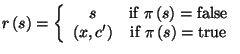
- A rule r is defined as a pair (,
 ) of a predicate and a target state, and it will be written as
  c for simplicity. A rule r=(,) is said to apply on a sample
  if the predicate returns true on the sample . Examples of rules include
and
Obviously, if the samples are interdependent, then the application of a
rule will be context-dependent.
if the predicate returns true on the sample . Examples of rules include
and
Obviously, if the samples are interdependent, then the application of a
rule will be context-dependent.
- Given a state
 and a rule
  , the state resulting from applying rule
  to state ,
  , is defined as
- We assume that we have some labeled training data
 which can be either a set of samples, or a sequence of samples,
depending on whether the samples are interdependent or not; We also assume the
existence of some test data
which can be either a set of samples, or a sequence of samples,
depending on whether the samples are interdependent or not; We also assume the
existence of some test data  on which to compute performance evaluations.
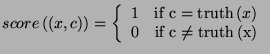
- The score associated with a rule
 is usually the difference in performance (on the training data) that
results from applying the rule:
where
is usually the difference in performance (on the training data) that
results from applying the rule:
where
The TBL algorithm can be now described as follows:
- Initialize each sample in the training data with a classification (e.g.
for each sample
 determine its most likely classification ); let
  be the starting training data.
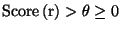
- Considering all the transformations (rules) to the training data
 , select the one with the highest score
and apply it to the training data to obtain
If there are no more possible transformations, or
, select the one with the highest score
and apply it to the training data to obtain
If there are no more possible transformations, or  , stop2.2.

- Repeat from step 2.
An easy observation that needs to be made is
that the pseudo-code presented above is an algorithm, i.e. it will finish on any
data that is given. The argument is simple: let us denote the number of errors
in by  . Then we have the following recurrence:
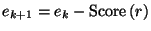 |
(2.1) |
Since
at each stage where we apply a rule, (2.1)
implies that  for any
  . Since
  , it results that the algorithm will stop at some point in time,
therefore avoiding, for instance, garden paths.
, it results that the algorithm will stop at some point in time,
therefore avoiding, for instance, garden paths.
The most expensive step in the TBL computation is the computation of the
rules' score. There have been many approaches that try to solve the problem in
different ways:
- In Brill's tagger [Bri95]
(probably the most used TBL software package), the rules are regenerated at
each step: only the rules that correct the errors are generated and the good
counts are computed this way; then they are examined in the decreasing order
of their good counts and the bad counts are computed by applying the rules to
each sample -- this approach has the advantage that it can stop early (i.e.
not evaluate rules whose score cannot be better than the best rule found so
far). The disadvantage is that it slows down considerably as the best rule
score decreases.
- Ramshaw & Marcus [RM94]
proposed a different approach: for each rule store all the positions in the
corpus where it applies and for each sample store the list of rules that apply
to it. This trick makes the update very fast, but unfortunately requires very
large amounts of memory.
- Samuel [Sam98]
presented a Monte-Carlo approach to TBL, where only a part of the rule space
is explored to determine the ``best'' transformation to apply to the data.
- Lager, in his
 TBL system [Lag99],
implements an efficient Prolog version of TBL, which achieves speed-ups by
``lazy'' learning.
TBL system [Lag99],
implements an efficient Prolog version of TBL, which achieves speed-ups by
``lazy'' learning.
fnTBL (as described in [NF01],
provided with the distribution) achieves its speedup by generating the rules
both for the good and bad counts computation. The main idea is to store the rule
counts and to recompute them as necessary, when a newly selected rule gets
applied to the corpus. The advantage is that only samples in the vicinity of the
application of the best rule need to be examined and the rules that apply on
them need to have their counts updated -- and to identify those rules, we are
``generating'' them -- using the set of templates to identify the rules that
apply on those positions and update their counts (good and bad) if necessary.
This approach can obtain up to 2 orders of magnitude speed-up relative to the
approach present in Brill's tagger.
Next: 3. System Description Up: Fast Transformation-Based Learning Toolkit Previous:
1. Preface Contents
Radu Florian 2001-09-12