Telex
Telex External
Link
External
Link Internal Link
 Inventory CacheTelexExternal
LinkInternal LinkInventory Cache
Inventory CacheTelexExternal
LinkInternal LinkInventory Cache
 |
Alan
Turing
This nOde last updated
January 5th, 2002 and is permanently morphing...
(5 Caban (Quake) - 15 (K'ank'in) - 57/260 - 12.19.8.15.17)

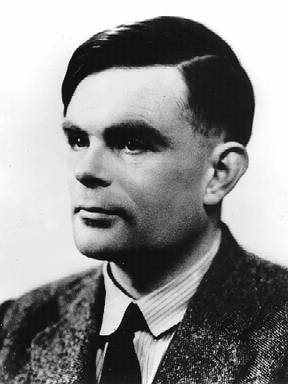
Turing, Alan Mathison, 1912-54,
British mathematician and computer theorist. His early work in predicate logic
led to a proof (1937) that some mathematical problems are not susceptible to
solution by automated computation. During World War II, he was instrumental in
breaking the German Enigma cipher. After the war he helped design computers and
did groundwork in the field of ARTIFICIAL
INTELLIGENCE.
process. Then he
became the top code-breaker in the world--when he wasn't bicycling around
wearing a gas mask or running twenty miles with an alarm clock tied around
his waist. If it hadn't been for the success of Turing's top-secret
wartime mission, the Allies might have lost Worlds War II. After the war, he
created the field of artificial intelligence and laid down the foundations of
the art and science of programming. He was notoriously disheveled, socially
withdrawn, sometimes loud and abrasive, and even his friends thought that
he carried nonconformity to weird extremes. At the age of forty-two, he
committed suicide, hounded cruelly by the same government he helped save.
-_Tools For Thought_ by Howard Rheingold
Sadie Plant, in
her book _Zeros And Ones_,
Turing commited suicide by eating an apple that was laced with cyanide (but this
might have been unintentional as apparently he was notioriously bad at washing
his hands after scientific experiments) and, he was found dead with an apple
with a couple of "bytes" taken out of it, and since the rainbow is the symbol
for homosexuality, which is why he was harrassed into suicide, the rainbow apple
with bytes missing for the Apple Mac symbol is actually a homage to
Turing.
 |
Turing test, a procedure to test whether a computer is capable of humanlike thought. As proposed (1950) by British mathematician Alan TURING, a person sits with a teletype machine isolated from two correspondents-one is another person, one is a computer. By asking questions through the teletype and studying the responses, the isolated person tries to determine which correspondent is human and which the computer. If that proves impossible, the computer is credited with having passed the test.
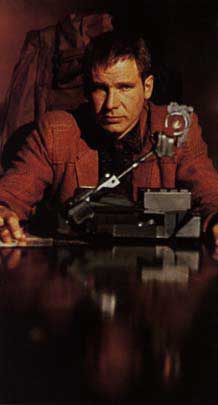
Similar to the Voight-Kampf test in _Blade
Runner_ but in
reverse.
 |
Usenet:
From: eagle!cw
(eagle!cw)
Subject:
What Is The Turing Test & Where Can I Find It?
Newsgroups: net.followup, net.misc
Date: 1982-11-30 23:45:57 PST
The Turing Test is a test for the existence of intelligence in an unknown device. Briefly summarized, it attaches you, via teletypes or another disguising communication medium, to two purported intelligences. One is known to be human; the other is the candidate under test. You may hold any conversation with the two devices. If, at the end, you can distinguish the human from the candidate intelligence, the candidate intelligence is deemed to have failed; it is not, in fact, human intelligent.
Of course, you must run this test several times because you have a 50% chance just by guessing.
The reference is to
Alan Turing. Can
A Machine Think? Reprinted in
James R. Newman, The
World of Mathematics, Simon and
Schuster, 1956.
Originally in the journal Mind in 1950.
Reprinted many other places as well.
This paper is essential reading for anyone who even wants to participate in a discussion of thought, much less of thought and computers.
Charles
TelexExternal
LinkInternal LinkInventory Cache