


Next: Case Assigners
Up: Case
Assignment Previous: Minimalism and
Case
The English XTAG
grammar adopts the notion of case and the case filter for many of the same
reasons argued in the GB literature. However, in some respects the English XTAG
grammar's implementation of case more closely resembles the treatment in
Chomsky's Minimalism framework [#!chomsky92!#] than the system outlined in the
GB literature [#!chomsky86!#]. As in Minimalism, nouns in the XTAG grammar carry
case with them, which is eventually `checked'. However in the XTAG grammar, noun
cases are checked against the case values assigned by the verb during the
unification of the feature structures. Unlike Chomsky's Minimalism, there are no
separate AGR nodes; the case checking comes from the verbs directly. Case
assignment from the verb is more like the GB approach than the requirement of a
SPEC-head relationship in Minimalism. Most nouns in English do not have separate
forms for nominative and accusative case, and so they are ambiguous between the
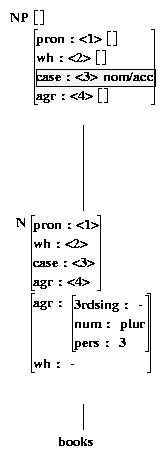
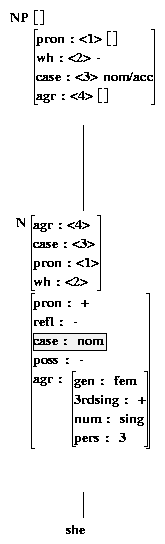
two. Pronouns, of course, are morphologically marked for case, and each carries
the appropriate case in its feature. Figures 4.3(a)
and 4.3(b)
show the NP tree anchored by a noun and a pronoun, respectively, along with the
feature values associated with each word. Note that books simply gets the
default case nom/acc, while she restricts the case to be
nom.
 |
0.5in |
 |
| (a) |
0.5in |
(b) |
- {Lexicalized NP trees with case markings
Next: Case Assigners
Up: Case
Assignment Previous: Minimalism and
Case
XTAG Project
http://www.cis.upenn.edu/~xtag/