Next: Unification-based
features Up: Feature-Based,
Lexicalized Tree Adjoining Previous: TAG formalism
`Lexicalized'
grammars systematically associate each elementary structure with a lexical
anchor. This means that in each structure there is a lexical item that is
realized. It does not mean simply adding feature structures (such as head) and
unification equations to the rules of the formalism. These resultant elementary
structures specify extended domains of locality (as compared to CFGs) over which
constraints can be stated. Following [#!schabes88!#] we say that a grammar is
LEXICALIZED if it consists of 1) a finite set of structures each
associated with a lexical item, and 2) an operation or operations for composing
the structures. Each lexical item will be called the ANCHOR of
the corresponding structure, which defines the domain of locality over which
constraints are specified. Note then, that constraints are local with respect to
their anchor. Not every grammar is in a lexicalized form.2.3
In the process of lexicalizing a grammar, the lexicalized grammar is required to
be strongly equivalent to the original grammar, i.e. it must produce not only
the same language, but the same structures or tree set as well.
- {Lexicalized Elementary trees
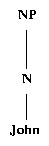
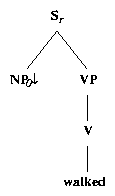
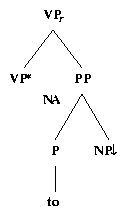
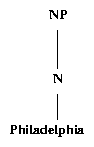
In Figure 2.4,
which shows sample initial and auxiliary trees, substitution sites are marked by
a  , and foot
nodes are marked by an
, and foot
nodes are marked by an  . This
notation is standard and is followed in the rest of this report.
. This
notation is standard and is followed in the rest of this report.
Next: Unification-based
features Up: Feature-Based,
Lexicalized Tree Adjoining Previous: TAG formalism
XTAG Project
http://www.cis.upenn.edu/~xtag/