


Next: The Grammar
Development Environment Up: System
Description Previous: Tree Database
Once a particular
set of lexicalized trees for the sentence have been selected, XTAG uses an
Earley-style predictive left-to-right parsing algorithm for LTAGs
([#!schabesjoshi88!#,#!schabes90!#]) to find all derivations for the sentence.
The derivation trees and the associated derived trees can be viewed using the
X-interface (see Table 3.1).
The X-interface can also be used to save particular derivations to disk. The
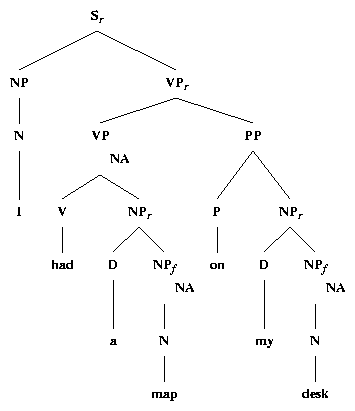
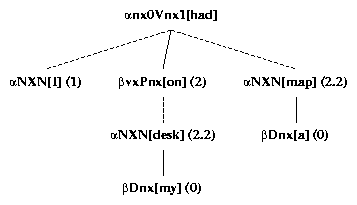
output of the parser for the sentence I had a map yesterday is
illustrated in Figure 3.2.
The parse tree3.3
represents the surface constituent structure, while the derivation tree
represents the derivation history of the parse. The nodes of the derivation tree
are the tree names anchored by the lexical items3.4.
The composition operation is indicated by the nature of the arcs: a dashed line
is used for substitution and a bold line for adjunction. The number beside each
tree name is the address of the node at which the operation took place. The
derivation tree can also be interpreted as a dependency graph with unlabeled
arcs between words of the sentence.
 |
 |
| Parse Tree |
Derivation Tree |
- {Output Structures from the Parser
| Part of Speech |
Description |
| A |
Adjective |
| Ad |
Adverb |
| Comp |
Complementizer |
| D |
Determiner |
| G |
Genitive Noun |
| I |
Interjection |
| N |
Noun |
| P |
Preposition |
| PL |
Particle |
| Punct |
Punctuation |
| V |
Verb |
- {XTAG tagset
Next: The Grammar
Development Environment Up: System
Description Previous: Tree Database
XTAG Project
http://www.cis.upenn.edu/~xtag/